Diane Ferraro is sixty-eight. Her mother Rose is ninety-two. Diane retired from her hospital administration job four years ago to care for Rose, who has moderate Alzheimer’s and lives with Diane in a ranch-style home Diane bought specifically because it had no stairs. Diane has not slept through the night in two years. She has lost fourteen pounds. Her own A1c, which was 5.6 in 2022, was 6.4 at her last appointment. Her primary care physician asked her gently whether she had thought about respite care. Diane said she would think about it. She did not think about it.
The caregiver concierge is the agent that serves Diane. Not Rose. Diane. This distinction matters, because the architecture of caregiving in America has historically treated caregivers as resources rather than as people. The person being cared for has health insurance, has clinicians, has services. The caregiver has a casserole brought by a neighbor on the second Sunday after the diagnosis and then disappears from view, even as her own health degrades under the load.
The caregiver concierge fills a gap that no other system in the household fills. Its primary user is the person who has become the coordination layer between every system and every family member, the person whose own needs are nobody’s job because she is everyone else’s job. Architecturally it works alongside the cognitive concierge that serves Rose, but it answers to Diane and represents Diane’s interests, including the interests Diane is too depleted to articulate.
The switchboard problem#
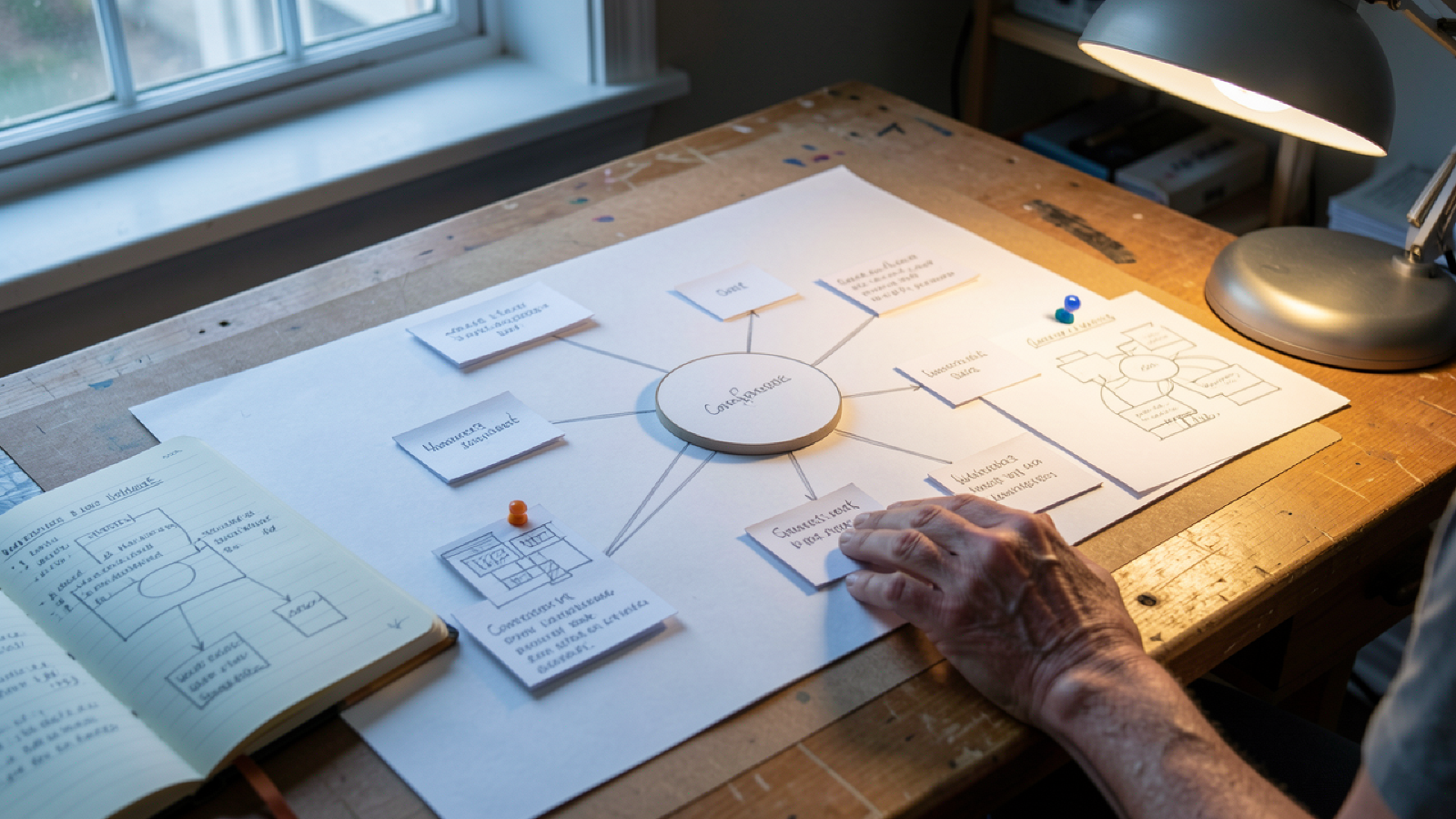
Diane is not just Rose’s caregiver. She is the household’s switchboard. Her brother in Phoenix calls weekly for an update on Mom, which Diane provides in a script she has refined across two years. Her mother’s neurologist’s office calls about appointment scheduling and pre-visit forms. The home health aide who comes Tuesdays and Thursdays texts when she is running late. The pharmacy calls about prior authorizations. The Medicaid worker calls about the spend-down documentation. The electrician needs access to install the bathroom grab bars. The visiting nurse is behind on her notes. The hospice intake nurse Diane interviewed last month called back with follow-up questions. Diane is the routing layer for all of it.
The architectural pattern that emerges is this: the caregiver becomes the integration surface that the household’s clinical, financial, social, and operational systems all touch. None of those systems coordinates with the others. Diane coordinates them by holding all the context in her head and translating between them as needed. The translation work is invisible. The cost of the translation work is also invisible, until the caregiver herself begins to fail under it.
The caregiver concierge takes over the switchboard. Not all of it: Diane is still the person who knows Rose, who recognizes when Rose is uncomfortable in ways nobody else would catch, who decides what the family does. The agent owns the routing, scheduling, and information distribution. Diane owns the judgment. The split is intentional and is the architectural foundation of the agent’s contribution.
Burnout detection through behavioral signals#
The agent monitors Diane’s own state through patterns in her communication, her schedule, and her interaction with the system. The signals are not invasive. They are properties of normal usage that a thoughtful human friend would also notice if she were paying attention.
Communication patterns. The agent observes the length, frequency, and tone of Diane’s messages within the BlueMirror interface. Shortening messages, decreasing frequency, more frustration markers (negation density, exclamation patterns, the specific lexical signatures that distinguish exhausted communication from neutral communication): these are not diagnostic individually, but cumulatively they are signal. A baseline drift across weeks indicates accumulating load.
Schedule patterns. The agent observes Diane’s own routine: when she sleeps and how long, when she eats and what, when she sees her own physician, when she sees her friends, when she leaves the house for reasons that are not Rose’s appointments. The deterioration of these patterns precedes burnout in well-documented ways. Sleep loss is the earliest signal in most cases.
Interaction patterns with the cognitive concierge. The agent observes how Diane is engaging with the household systems: is she still reading the weekly summary or has she stopped, is she still responding to non-urgent prompts or has she fallen behind, is she still adjusting Rose’s care plan or is she letting it run on autopilot? Disengagement from the systems is itself a signal of caregiver depletion.
The agent does not produce a “burnout score” because reducing the caregiver to a number reproduces the problem the architecture is trying to address. The agent produces a structured assessment that surfaces concerns at the moments they are actionable. When the patterns indicate accumulating load, the agent surfaces respite options to Diane in a register that respects her authority and avoids the implication that she is failing. “Diane, I noticed you have not had an evening to yourself in seventeen days. The Senior Companion volunteer through the county is available Saturday from one to five. Would you like me to arrange it?” Not “you appear to be experiencing burnout.” Not “studies show that caregivers who do not take regular respite suffer worse health outcomes.” The agent treats Diane as a competent adult who is making rational tradeoffs under hard constraints. It surfaces options that change the constraint.
Respite facilitation#
The agent’s most operationally consequential function. Most caregivers do not take respite because organizing respite is itself work. The work of finding the respite provider, vetting them, matching them to the care recipient’s needs, scheduling them, briefing them on the care recipient’s preferences and routine, paying them: all of this falls on the caregiver in the hours she does not have.
The agent owns the respite logistics. It maintains a vetted network of respite providers per geography: county-level senior companion programs, paid in-home respite agencies, adult day programs, hospice respite (when applicable), volunteer organizations. It matches providers against Rose’s specific care needs (the moderate Alzheimer’s, the medication schedule, the wandering risk after 4 p.m., the aversion to crowds). It schedules across the month, not just the next week. It briefs the provider on Rose’s routine and preferences from the cognitive concierge’s structured care context, with Diane’s review. It handles the payment routing through whatever combination of long-term care insurance, Medicaid waiver coverage, and out-of-pocket payment Diane has set up.
The friction reduction is the contribution. The pattern of “caregiver knows she should take respite but does not because organizing it is hard” is the pattern the agent breaks. When the friction approaches zero, the respite happens. When the respite happens, the caregiver’s depletion slows. The slowing of caregiver depletion is what determines whether Diane can continue to care for Rose at all.
As of mid-2026, the vetted respite network is operational in a focused pilot geography (initially three states with established Medicaid waiver programs and active senior companion infrastructure). Expansion to broader U.S. coverage runs through 2027 and 2028, dependent on the build-out of regional respite provider networks the platform partners with. The pilot operates today. The full coverage is what twelve to twenty-four months of build look like.
Balancing two sets of needs#
The caregiver concierge sits in a structurally complex position: it serves Diane, but Rose is the person whose decline is the precipitating context. The agent’s loyalty is to Diane. The agent’s awareness is shaped by Rose’s situation, with Rose’s consent (preserved through the cognitive concierge’s continuing tracking of her capacity to consent and the proxy structure that activates as her capacity changes).
The architecture handles this through a clearly bounded information model. The caregiver concierge sees what Diane needs to see to caregive: Rose’s medication schedule, the upcoming appointments, the symptoms that have arisen, the cognitive trajectory at the granularity Diane has authorized through the family coordination concierge. The caregiver concierge does not see information about Rose that Rose has chosen to keep private (the moments of fear or confusion she has confided to the cognitive concierge, for example, in the period when she could still do so).
When Rose’s interests and Diane’s interests diverge, the agent makes the divergence visible without pretending it can be resolved by software. The classic example: Rose wants to remain at home. Diane is exhausted to the point of her own health failure. The architecture cannot decide between these. It can surface the tradeoffs (Diane’s A1c trajectory, the respite availability, the cost and quality of memory care alternatives, the family conference that would consider the question) and route the decision through the family coordination concierge with all parties informed. The decision belongs to the humans. The agent’s contribution is the visibility.
The caregiver who is also aging#
Diane is sixty-eight. The architecture recognizes that the caregiver is, in many cases, herself an aging adult. The pattern is increasingly common: the seventy-year-old daughter caring for the ninety-year-old mother, the seventy-five-year-old wife caring for the eighty-year-old husband. The caregiver concierge does not assume the caregiver is younger or more resourced than the care recipient.
What this means in practice. The agent watches Diane’s own health markers with attention proportional to her age. Her own medication regimen is tracked through her own health concierge instance. Her own appointment schedule is coordinated. Her own social isolation risks are monitored. The caregiver concierge does not run her health concierge (every aging adult who uses the system has her own health concierge, including caregivers), but it integrates with hers, surfacing concerns that the caregiver role might be obscuring. The pattern of “caregiver puts off her own colonoscopy because she cannot leave the care recipient alone for the prep day” is the pattern the agent breaks: the agent surfaces it, identifies the respite that would cover the prep day, and supports Diane in scheduling her own care.
The caregiver concierge’s most important property may be its insistence that Diane is also a person. The American care system has tended to treat caregivers as the unpriced labor that allows the care system to function at all. The architecture refuses this framing. Diane has her own life trajectory. The agent serves it.
What the caregiver concierge cannot do#
It cannot replace the caregiver’s judgment. The agent does not know that Rose hates the smell of lavender, even though most cognitively impaired adults do well with lavender as a calming scent. The agent does not know that Rose’s preferred routine on Sundays involves listening to specific Italian opera recordings from the 1960s that meant something to her in the early years of her marriage. Diane knows. The agent learns these things from Diane and from observation, but the depth of caregiver knowledge is not something software can construct independently.
It cannot make hard decisions about care transitions. The decision to move Rose into memory care is a decision that involves Diane, Rose, the family, the clinicians, and the financial reality. The agent supports the decision with information. It does not make the decision. It would not be correct for it to make the decision.
It cannot solve the structural problem. The caregiving crisis in America is structural: there are not enough caregivers, the caregiving workforce is underpaid, family caregivers are unsupported, the policy environment for caregiving is fragmented across Medicaid, Medicare, the VA, state programs, and the private long-term care insurance market. No agent solves this. The agent improves Diane’s situation within the structure that exists. The structure itself requires policy work that lies outside this architecture.
The next article addresses the social connection concierge: the agent that recognizes isolation as a clinical risk and creates conditions for connection without manufacturing it.
Cross-References#
Caring for the Caregiver (BML-06 series). The editorial framing of caregiver experience that this agent serves, including the human texture of the switchboard problem and the burnout trajectory.
The Family Coordination Concierge (BMT-01.14). The related concierge that manages family members’ interaction with care decisions, including the consensus building that the caregiver concierge supports but does not own.
The Escalation Hierarchy (BMT-04.04). The framework that governs how decisions surface to family members and clinical providers when the agent identifies that a transition or intervention is needed.
The Learning and Literacy Concierge (BMT-01.15). Where the subscriber has authorized caregiver literacy support, the learning concierge serves the caregiver with the same adaptive approach it uses with the subscriber; caregiver health literacy directly affects care quality.
The End-of-Life Concierge (BMT-01.16). The caregiver concierge’s communication and burnout monitoring functions take on added complexity in the end-of-life context; the two agents coordinate on caregiver support as the care circle’s demands intensify.
Technical Appendix BMT-01.08-A is available to partners and investors at partners.bluemirror.tech.