BMT-01.12 Executive Summary#
BlueMirror.tech | May 2026#
The night after Margaret’s poor sleep, the lights came on at sixty percent of their normal level, ten minutes earlier than her usual rise. The bedroom was already three degrees warmer than the previous morning. The bathroom had pre-warmed the floor. The kitchen had brewed the coffee at a slightly stronger setting because the system had learned that on bad-sleep mornings Margaret reached for stronger coffee. None of these adjustments was announced. None required Margaret to do anything. None followed an explicit instruction she had given. They emerged from a model of her preferences that the system had built across months of observation, refined against her implicit feedback, and acted on without ceremony.
The home environment concierge manages the living environment inside the home: ambient conditions, safety adaptations, the texture of the physical space the person inhabits across the day. It is distinct from the home maintenance concierge, which manages the physical plant. The maintenance concierge schedules the HVAC service. The environment concierge sets the thermostat against Margaret’s actual patterns. They share the property profile but operate at different timescales and answer different questions. The home environment concierge is also the architectural seat of the robotics integration roadmap. The agent that knows how Margaret moves through her house, what conditions support her through the day, what safety considerations apply to her current state, is the agent that any future robotic system in the home would integrate with. The robot does not build its own model of the person. It calls BlueMirror.
Living environment management is continuous and inferential. What temperature does Margaret prefer at 6 a.m. compared to 11 a.m. compared to 9 p.m.? Which lighting patterns support her through the late afternoon when sundowning patterns risk her cognitive state? Which acoustic conditions does she find comforting and which does she find oppressive? The answers are not in a manual. They emerge from observation, are continuously refined, and produce small adjustments hundreds of times across a day. A maintenance schedule cannot be the answer to the living environment question, and a continuous adaptive system cannot be the answer to the maintenance question. The architecture separates them because conflating them would distort both.
The agent’s foundation is a multi-modal sensing layer that infers Margaret’s state and her environment without invasive monitoring. Sensing categories include passive infrared motion sensors per room, ambient temperature and humidity, light levels, low-resolution acoustic patterns (presence of conversation, presence of TV, ambient noise level, never speech content recognition without explicit consent), door and window contact sensors, and appliance signatures from the home’s electrical panel. The architectural contribution is integration, inference, and the privacy framework that constrains what the data is used for. The privacy framework is non-negotiable. Sensor data stays on local edge hardware in the home. Patterns and inferences are summarized into the MoC at appropriate granularity. Raw sensor data does not leave the home unless the user has specifically authorized a transfer for a specific use case. The home does not become a stream of telemetry to a cloud service. It becomes a sensor mesh that produces a model the person owns. The inference layer runs on edge hardware that costs $300 to $600 to deploy in the typical single-family home.
The agent’s most consequential function is safety adaptation. As Margaret’s risk profile changes, the home environment changes to match. Fall risk integrates the health concierge’s gait analysis, the cognitive concierge’s state assessment, and its own observation. When the score crosses a threshold, the environment shifts: pathway lighting activates more aggressively at night, the bathroom floor maintains a warmer temperature, the bed-to-bathroom path is illuminated to support navigation without disrupting sleep. Cognitive support is the second example. When the cognitive concierge detects sundowning patterns, the environment responds: lighting warms toward the spectrum that has historically supported Margaret on calm afternoons, music plays at the volume and selection she has tended toward in calmer states, the temperature shifts up half a degree because the agent has learned that Margaret tends to be cold during anxious periods. The environment does not announce these changes. They simply happen. Wandering safety is the third. When Margaret approaches an exit at an unusual hour, the environment can offer a gentle redirect: the kitchen lights brighten, the kettle starts, the music shifts to something familiar. The safety intervention is environmental, not restraint-based. The architecture refuses restraint-based interventions in favor of environmental redirection that respects Margaret’s authority to remain in her own home. The honest limitation: environmental redirection works for many wandering scenarios and not for all.
The agent’s adaptation is continuous and does not require Margaret to configure the house. The temperature she keeps the house at on weekend mornings is different from weekday mornings. The lighting she uses when she reads is different from when she cooks. The bathroom temperature she prefers in winter is different from summer. None of this is configured in a settings menu. The agent observes the manual adjustments Margaret makes, infers the difference between her adjustments and the system’s defaults, and shifts the defaults toward the patterns that produced fewer manual interventions. The naïve approach would be to ask Margaret to rate her environment, which would require her to attend to the environment as a managed system. The architecture refuses this approach. It uses Margaret’s own actions (the thermostat adjustment, the lamp she turns on, the shade she lowers) as the signal. Her actions reveal her preferences.
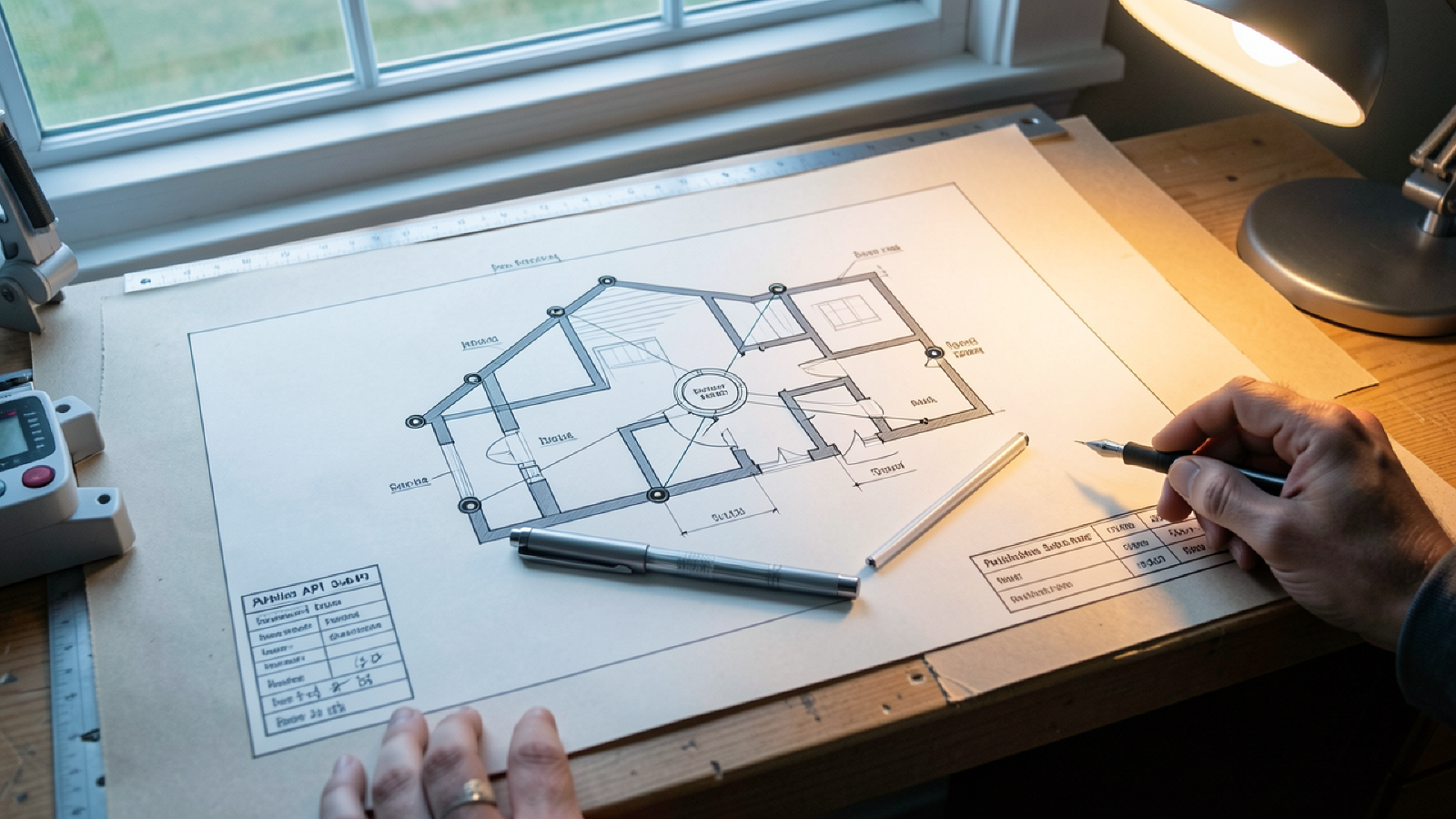
The robotics integration runs through a published API that exposes specific elements of the home context to authorized robotic systems: the room layout, the current location of human occupants, the safety zones, the environmental state. The robot reads from this API to navigate, plan, and act safely. The robot does not build its own personalization model. The architecture refuses that pattern; each robot building its own model would multiply the surveillance and the data fragmentation. The unified context, exposed through controlled APIs, keeps Margaret’s information coherent. This is a 2027 capability in its first form, with the API in design and prototype integrations under construction with two robotics partners. Broader deployment runs through 2028 and 2029. The architecture is built today against a future the robotics industry is approaching.
Sensor fusion across modalities is non-trivial because the modalities have different characteristics. Wearable data provides the highest-resolution view of physiological state but is limited to the body. Home sensors provide spatial coverage but cannot see what is happening inside a person. The fusion produces a unified state estimate more reliable than any single modality. The architectural challenge is uncertainty management. The agent’s state estimate is always probabilistic. The agent does not announce certainty when it lacks certainty. When the wearable data and the home sensor data disagree about whether Margaret is sleeping, the agent does not assume either; it defers action that depends on certainty and proceeds with action insensitive to either case.
Honest limits matter. The agent cannot operate without sensors; in homes without them, the agent operates on reduced data with reduced value. It cannot replace human judgment about safety; the fall risk score is a guide, not a verdict. It cannot be the only sensor. Some changes happen outside the agent’s view. Margaret may have felt dizzy this morning without reporting it or her wearable detecting the orthostatic pattern that produced it. The architecture is honest about the gap between what sensors detect and what humans experience.
For the full treatment of the living-environment-versus-physical-plant distinction, ambient monitoring, safety adaptation, and the robotics integration roadmap, read the complete article on BlueMirror.tech.