Frank Doherty’s wife managed everything. For forty-one years, Helen kept the calendar of the house: the HVAC service in spring and fall, the gutters in November, the water heater anode rod every five years, the deck staining every three, the dryer vent every two, the furnace filter every three months, the smoke alarm batteries every year on her birthday. She did not consult a list. She held it in her head. When she died in February, the house went unmanaged for fourteen months before Frank realized he did not know what he did not know.
The HVAC failed in August. The repair cost $4,800. Two weeks later the dryer caught a small fire from a clogged vent, extinguished quickly, but the laundry room needed remediation, $7,200. The gutter that overflowed in the November rain rotted the soffit. By Christmas the cumulative deferred maintenance had cost Frank $19,000, and the bigger problem was not the money. The bigger problem was that one weekend in October, climbing the wobbly garage stair to retrieve a Christmas decoration, Frank slipped, hit his hip, and broke his femur. The fall, the surgery, the rehab, the conversation with his daughter about whether he could continue to live alone: all traceable to a stair tread that Helen would have replaced two years before Frank ever climbed it.
The home maintenance concierge transforms this trajectory. Not by replacing Helen, who held the property in her head with a precision and care that no software approaches. By organizing the property, the schedule, the vendors, and the budget into a system that does the procedural work Helen did and surfaces decisions for Frank in plain language at the right moments. The deferred maintenance crisis is not inevitable. It is what happens when the coordinator is gone and no system fills the role.
The deferred maintenance problem#
What happens when nobody manages the house. The pattern is consistent across the population. Fourteen small repairs accumulate because nobody coordinates them. Each one is minor in isolation: the loose railing, the slow drain, the exterior caulking, the worn weatherstripping, the appliance with the intermittent fault. Together they create an unsafe living environment.
The cascade is well-documented in geriatric outcomes research. Loose railing leads to fall. Fall leads to hospitalization. Hospitalization leads to deconditioning, which leads to discharge to skilled nursing for rehab. Skilled nursing leads to the conversation about whether Dad can continue to live independently, which leads to assisted living or in-home care, which leads to drawing down the assets Frank had hoped to leave to his children. The original loose railing cost two hundred dollars to repair. The cascade has cost some families a hundred thousand and the parent’s home.
The home maintenance concierge does not eliminate the risk. Falls happen. Houses age. The architecture’s contribution is to convert the work from reactive (something failed; what now?) to proactive (something will need attention in March; here is the plan). Most of the cost in deferred maintenance is not the cost of the repairs. It is the cost of the repairs not having happened on the schedule that prevents larger consequences.
The property profile#
The agent’s foundation is a structured model of the specific property: not a generic checklist for “homes,” but a specific schedule for this house. The model includes building age, square footage, construction type, HVAC equipment with installation dates and service history, water heater type and age, roof material and last replacement date, electrical service capacity, plumbing material, major appliance inventory with warranty status, foundation type, exterior material, climate zone.
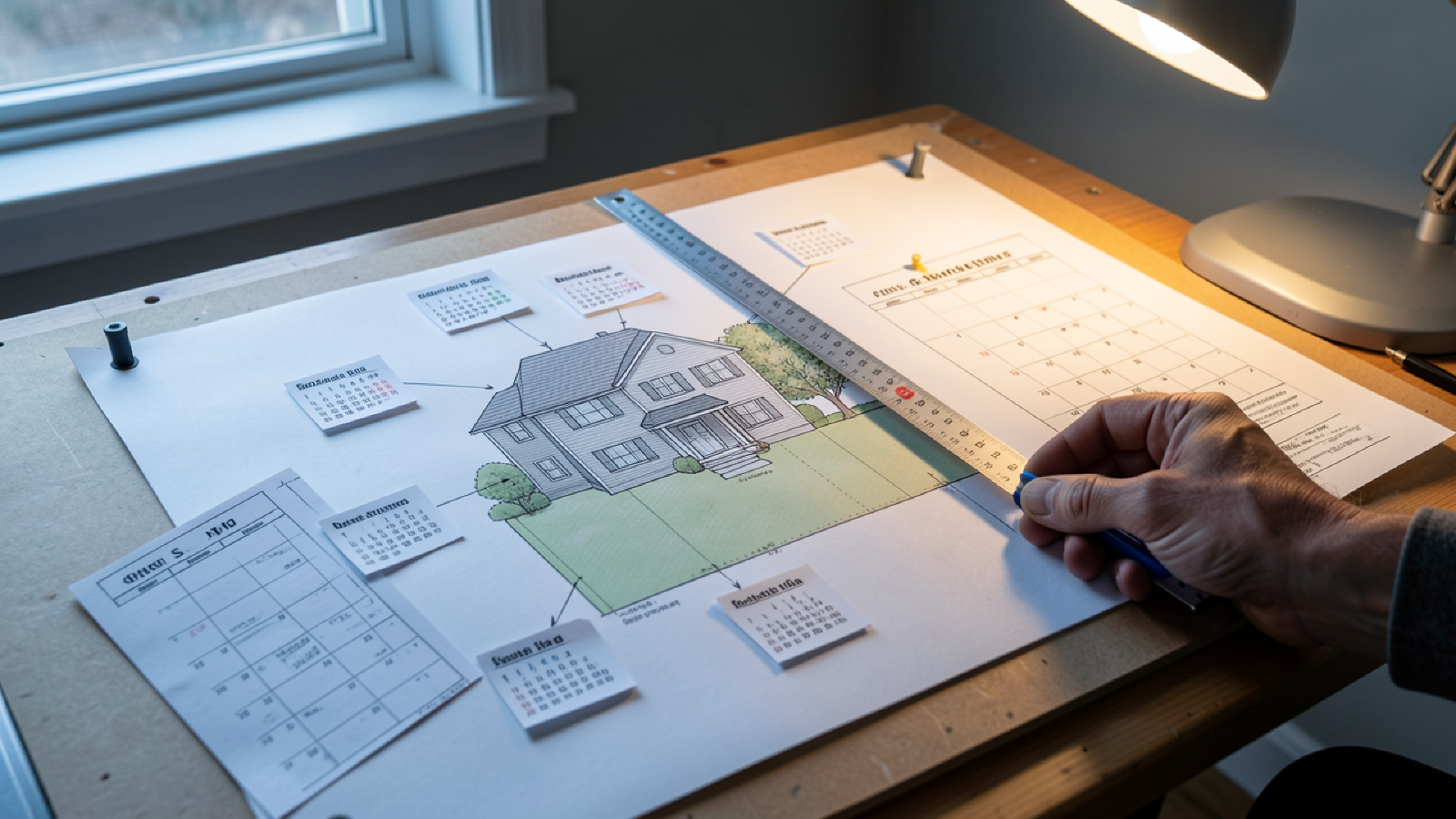
From this profile, the agent generates a maintenance calendar specific to the house. Frank’s HVAC is a 2017 high-efficiency gas furnace and 2015 central AC, in Pennsylvania. The calendar specifies: annual furnace inspection in October, AC service in April, filter changes every three months (with adjustment if the house has heavy pet dander or proximity to dusty roads), humidifier maintenance in November, condensate line cleaning in spring. Frank’s water heater is a 2018 50-gallon gas unit with a sacrificial anode. The calendar specifies: anode rod inspection at the seven-year mark (2025, currently overdue), annual flush. The roof was last replaced in 2014; the calendar specifies inspection at year ten and biannual after, with attention to the southern exposure that ages faster.
Generic maintenance lists from home improvement websites do not produce this calendar. They produce a list of categories. The agent produces a schedule of specific actions for the specific systems in the specific house in the specific climate. The architectural value is the specificity.
The property profile is built from three sources: the person’s input where the data is known (the year the roof was replaced, the brand of the furnace), public records where the data is verifiable (the building permit history, the assessor’s record), and inference where neither is available (the agent estimates the water heater’s age from its visible characteristics if Frank does not remember the installation date). The profile is updated as data becomes available; a service visit confirms the actual installation date, replacing the estimate.
Contractor vetting and coordination#
Most deferred maintenance is not a knowledge problem. It is a coordination problem. The person knows the gutter needs cleaning. The person does not know which gutter cleaner is reliable, fairly priced, and licensed for the work. The work fails to happen because finding the answer to that question is harder than living with the dirty gutters.
The agent’s contractor network is a vetted set of service providers per geography, with verifiable credentials and pricing transparency. Licensing is verified against state licensing boards. Insurance is confirmed through certificates of insurance. Reviews are aggregated across multiple sources, with weighting that suppresses the gaming patterns common on review platforms. Pricing is benchmarked against regional averages, surfaced to the person before any commitment, and tracked across time so that drift becomes visible.
Service history per contractor is logged. The HVAC technician whose seasonal tune-up took 45 minutes last spring and 15 minutes this spring with no documented reason is flagged. The electrician whose work passed inspection on three jobs with no callbacks is preferred for the next electrical work. The pattern is what individual homeowners cannot see because they do not have enough data points. The agent has the data points across the population it serves.
Coordination across multiple repairs is the operational gain. Frank’s house has fourteen items on the deferred list: the gutter cleaning, the dryer vent, the loose railing, the running toilet, the loose deck board, the faulty doorbell, the storm door that does not close cleanly, the outdoor faucet, the missing weatherstripping, the GFCI outlet that trips, the squeaky bathroom fan, the chipped exterior paint near the back door, the smoke alarm battery (overdue), the carbon monoxide detector at the end of its 7-year service life. The agent groups the items by trade. Two visits from a handyman for the small items: railing, deck board, doorbell, storm door, weatherstripping, smoke alarm, carbon monoxide detector, exterior paint. One visit from a plumber for the toilet, outdoor faucet, and bathroom fan. One visit from an electrician for the GFCI. One specialist visit for gutters and dryer vent. Total coordination: five visits across four trades, scheduled across three weeks, with a single unified payment trail. The same fourteen items, uncoordinated, would require Frank to find five different vendors, schedule five different visits, manage five different invoices.
The car integration#
The car is part of the home maintenance concierge because, for most aging adults, transportation maintenance is logistically inseparable from home maintenance. The same person manages both. The same calendar tracks both. The same vendor relationships often span both (the home insurance and auto insurance are typically the same carrier; the credit card that pays for the HVAC service is the credit card that pays for the brake job).
The agent maintains mileage-based and time-based maintenance schedules using manufacturer-specific recommendations. Oil changes per the actual oil type and driving pattern (synthetic at 7,500 miles or annually, conventional at 3,000 or six months). Brake inspections, tire rotations, transmission fluid, coolant flushes, timing belts at the specific intervals the manufacturer specifies for the specific model and year.
Pricing comparison runs across dealer service, independent mechanics, and tire and brake specialty shops. The independent mechanic with a reputation for honest work on Frank’s Subaru is often forty percent cheaper than the dealer for the same work, with equivalent or better quality. The agent surfaces both options with cost comparison and waits for Frank’s choice.
Warranty tracking ensures covered repairs are not paid out of pocket. Recall monitoring catches the recall notices that get lost in mail. Inspection reminders catch the state inspection deadline that, if missed, results in a citation. The car is managed alongside the house because the failure modes are the same: the small thing missed becomes the large thing later.
What the agent cannot do#
No software replaces the physical walk-through. The small crack in the foundation wall that an experienced inspector would notice. The discolored ceiling tile suggesting a slow leak above. The soft spot in the deck boards that indicates rot under the surface. The settling pattern in the back wall that might be normal foundation movement or might be a structural concern. These observations require a trained human eye in the physical space.
The home maintenance concierge does not inspect. It manages the schedule and the vendors. The annual inspection by a qualified home inspector remains a human function in the architecture. The agent schedules the inspector. The agent receives and organizes the inspector’s report. The agent prioritizes the items the inspector identifies. The inspector makes the observations.
The agent also cannot evaluate truly novel situations. The peculiar smell that started last week. The intermittent noise that occurs only when the AC and the dishwasher run together. These are diagnostic puzzles where the agent helps Frank document what he is observing and helps him communicate the documentation to a contractor, but the diagnostic work belongs to the contractor with the physical access and the trained eye.
These limitations are honest. A home maintenance concierge that claimed to inspect houses through software would be selling something it cannot deliver. The agent’s value is in the procedural work: the scheduling, the vetting, the coordination, the budget tracking, the reminder cadence. The physical work, including the physical inspection, remains human.
What changes for the person#
Frank’s house, fourteen months after Helen died, was a slow-motion safety hazard. Frank’s house, fourteen months after the home maintenance concierge was deployed, is on a calendar that runs ahead of the failures. The HVAC was serviced before the August heat. The dryer vent was cleaned before the lint accumulated. The garage stair tread was replaced before Frank ever climbed it again. The fourteen deferred items were closed in five vendor visits across three weeks.
The architecture cannot bring Helen back. It can fill the role she filled, in the procedural sense, so that the absence of the coordinator does not become a cascade of consequences that her care would have prevented. The next article addresses the cognitive concierge: the most ethically complex agent in the system, and the one whose design decisions are inseparable from the question of dignity.
Cross-References#
The House, the Car, and the List That Never Ends (BML-02.06). The editorial framing of the deferred maintenance problem from the user’s perspective, including the human texture of what happens when the household coordinator is gone.
The Home Environment Concierge (BMT-01.12). The related concierge that manages the living environment inside the house, distinguished from the physical plant management that this agent owns.
Care Agency Integration (BMT-09.03). The integration model for home care agencies whose service planning depends on understanding the property they are sending caregivers into.
Technical Appendix BMT-01.06-A is available to partners and investors at partners.bluemirror.tech.