Keiko Tanaka evaluates health technology platforms for a PE fund that focuses on senior living and post-acute care. She has seen enough “tiered service” models to recognize the pattern: the cheapest tier strips out the features that matter, the middle tier is the real product, and the premium tier bundles features nobody asked for to justify the price. The tier structure is a pricing strategy disguised as a product architecture.
She expected the same from BlueMirror. She did not find it. The base platform is the same for every subscriber. The deployment path varies; the product does not. What BlueMirror calls “service tiers” are optional add-ons available beyond the base concierge platform, not gates that determine whether a subscriber gets the real product or a diminished version of it.
The base platform: what every subscriber gets#
Every subscriber, on every deployment path, receives the full concierge architecture.
All fifteen concierge agents are available through voice, text, and visual interfaces. The Health Concierge, the Financial Concierge, the Buying Agent, the Legal Advocate, the Home Maintenance Concierge, the Cognitive Concierge, the Caregiver Concierge, the Social Connection Concierge, the Nutrition Concierge, the Earning Concierge, the Home Environment Concierge, the Purpose and Deployment Concierge, the Family Coordination Concierge, the Learning and Literacy Concierge, and the End-of-Life Concierge. The Memory of Context architecture (BMT-05.01) holds the subscriber’s identity, preferences, history, deep knowledge, and predictive models regardless of path. The P-RLHF personalization system (BMT-05.02) learns how the subscriber prefers to interact. The Blue Pane membrane (BMT-03.01) governs every outbound data flow. The orchestration logic (BMT-02.01) coordinates agent collaboration.
Privacy-critical processing runs in Zone 1 if the subscriber has it, in Zone 2 if she has regional coverage but no Zone 1, or in Zone 3 if she has neither. Heavy inference runs in Zone 2 if she has regional coverage, in Zone 3 otherwise. Deep reasoning is available in Zone 3 to every subscriber. The base platform is the same across all six deployment paths.
No “cheaper tier equals less private” framing exists because the equity commitment is to architectural consistency across paths. The privacy posture differences across paths (BMT-09.01) reflect the subscriber’s hardware situation, not her service tier. A Path F subscriber does not receive a “basic” version of the concierge. She receives the full concierge with a different compute substrate beneath it. The concierge does not know or care which path the subscriber is on. The orchestration layer routes queries to the appropriate zone; the subscriber’s experience of the concierge is the same.
The base platform also includes the safety architecture. The Safety Filter, the Medication Interaction Checker, the Emergency Detection system, and the Cognitive State Estimator operate for every subscriber on every path. Where these models run depends on the path: on the Local Pane for Paths A and B, on the phone for Paths C and D, or in Zone 2 or Zone 3 for Paths E and F. Where they run affects privacy posture and offline availability. It does not affect their accuracy, their sensitivity thresholds, or the clinical logic they apply.
Optional add-on: home sensor integration#
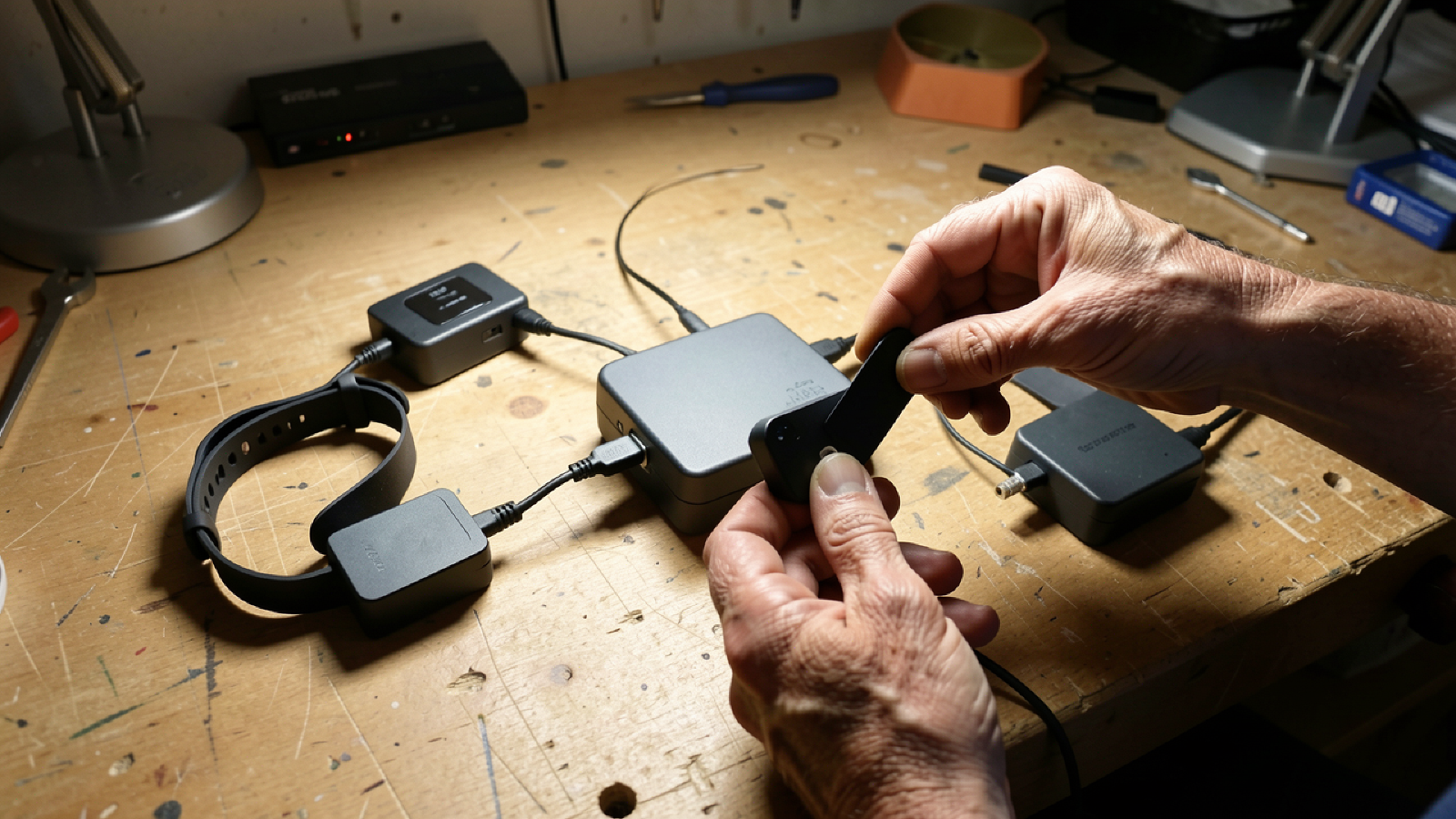
Home sensor integration is available to subscribers with Zone 1-Dedicated. The Local Pane device functions as the sensor hub, receiving data from wearable devices over BLE and from home sensors over Zigbee, Z-Wave, or Thread protocols.
The sensor integration includes wearable data ingestion (heart rate monitors, pulse oximeters, fall detection pendants, sleep tracking devices, continuous glucose monitors), environmental sensors (motion sensors for activity pattern detection, ambient temperature and humidity, mattress sensors for sleep quality, door and window contact sensors for safety monitoring), and home device integration (smart plugs for appliance usage patterns).
Institutional channels that fund the Local Pane hardware typically include sensor integration at no additional cost to the subscriber because the care coordination value of continuous monitoring justifies the inclusion. For direct-to-consumer subscribers who purchase a Local Pane device, sensor kits are available as add-on purchases.
Subscribers with Zone 1-Phone can integrate phone-based sensors and Bluetooth wearables paired with their phone. The phone receives wearable data over BLE and reads its own onboard sensors (accelerometer for fall detection, GPS for location if consented). What Zone 1-Phone lacks compared to Zone 1-Dedicated is the always-on home sensor mesh. The phone is not always in the room. The phone is not always plugged in. The phone does not coordinate a network of home environmental sensors. The Zone 1-Phone sensor capability is real but bounded.
Subscribers without Zone 1 (Paths E and F) do not have local sensor integration through the platform. Wearable devices that transmit data directly to cloud services can still be integrated at the platform level through partner APIs, but the integration is not local and the data traverses the network to reach Zone 2 or Zone 3 for processing.
Optional add-on: home robotics integration#
The Local Pane device acts as the ROS (Robot Operating System) bridge for home robotics. Subscribers with Zone 1-Dedicated can integrate compatible service robots: assistive robots for mobility support, cleaning robots with BlueMirror-aware scheduling, delivery robots for medication and meal delivery within the home.
The integration requires the local compute and hub functionality that the dedicated device provides: real-time sensor fusion between the robot’s sensors and the home sensor mesh, low-latency command routing, and safety override capability. A cloud round-trip for robot control commands introduces latency that is unacceptable for physical safety functions. When a mobility-assist robot is helping a subscriber stand from a chair, the safety system needs to process the force sensor data and the subscriber’s balance telemetry in single-digit milliseconds. That processing must happen locally.
The safety override architecture operates at three levels. Level one is the robot’s own onboard safety system, which the Local Pane does not override. Level two is the BlueMirror safety layer, which monitors the interaction through the home sensor mesh and can issue a stop command if the system detects a dangerous condition the robot’s own sensors missed, such as an obstacle detected by a separate motion sensor that the robot’s cameras cannot see. Level three is the subscriber’s voice command: “stop” terminates all robot movement immediately regardless of what operation is in progress.
Home robotics integration is early-stage. The compatible device list at launch is small: two assistive robot platforms and three cleaning robot brands. The ROS bridge supports standard ROS 2 message types, and the compatible device list will expand as manufacturers adopt BlueMirror’s integration specifications. The appendix (BMT-09.04-A) details the current compatibility matrix and integration requirements.
Subscribers without Zone 1-Dedicated cannot integrate home robotics through BlueMirror. This is a genuine limitation of the paths without dedicated local hardware, and the architecture does not pretend otherwise. The robotics add-on is available only to Path A and Path B subscribers.
Optional add-on: family coordination dashboard#
The family coordination dashboard is available to subscribers on any deployment path. It is a web-accessible interface for designated family members showing care plan status, medication adherence, daily engagement summaries, and emergency contact information. Each family member’s access scope is managed through the consent architecture (BMT-04.03): the subscriber controls which family members see which categories of information.
The dashboard does not expose raw MoC data to family members. It presents processed summaries: “Mom took all her medications today,” not the medication list itself unless the subscriber has consented to share medication details with that family member. The Blue Pane membrane governs the dashboard’s data flows with the same enforcement semantics as any other external data sharing. A family member cannot escalate her own access. The subscriber must explicitly grant each information category to each family member, and the subscriber can revoke access at any time through a voice command to the concierge.
The family coordination dashboard addresses one of the most common requests from adult children who enroll parents: “I want to know that Mom is okay without calling her three times a day.” The dashboard provides that visibility within the privacy boundaries the subscriber sets. For institutional channels, the dashboard also supports care team members (PACE coordinators, home health aides, primary care providers) with appropriate consent and access scoping distinct from family member access.
What is not tiered#
The deployment path determines where processing happens. It does not determine what processing is available.
The Tiny LMs that run in Zone 1 are the same Tiny LMs that run in Zone 2 or Zone 3 for subscribers without Zone 1. The Cognitive State Estimator that runs on a Path A subscriber’s Local Pane device is the same model, with the same weights, producing the same output quality, as the Cognitive State Estimator that runs in Zone 3 for a Path F subscriber. The processing location differs. The processing quality does not.
The MoC architecture is the same across all paths. Every subscriber has five context layers. Every subscriber’s MoC is populated from enrollment data and refined through interaction. The membrane enforcement semantics are the same. The orchestration logic is the same. The fifteen concierge agents are the same. The deep reasoning available through Zone 3 is the same.
The service tiers (the optional add-ons described above) add capabilities that depend on specific hardware configurations. They do not subtract capabilities from the base platform for subscribers who lack that hardware.
The equity commitment#
The same ethical framework, the same safety monitoring, the same privacy protections apply at every funding source and every deployment path.
The Viability Gap Fund subscriber on Path F gets the same concierge architecture as the self-paying subscriber on Path A. The subscriber enrolled through a Medicaid HCBS waiver gets the same fifteen agents as the subscriber enrolled through a PACE program that funded her full hardware stack. The subscriber whose adult child enrolled her through an employer benefit gets the same deep reasoning as the subscriber who found the platform herself and purchased every add-on.
What differs is hardware ownership and the privacy substrate. What does not differ is product capability, reasoning depth, or the system’s commitment to serving the subscriber’s interests. The funding firewall (BMT-10.02) ensures that no funder influences the subscriber’s experience, recommendations, or data. The architecture is designed so that the subscriber who costs the most to serve (Path F, Zone 3-only, Viability Gap Fund) receives the same product as the subscriber who costs the least (Path A, full hardware stack, PACE-funded).
That is not an aspiration. It is an architectural constraint.
Cross-References#
BMT-09.01 The Three-Zone Architecture. The deployment paths and privacy hierarchy that the service tier structure operates within.
BMT-01.12 The Home Environment Concierge. The concierge agent that relies on Local Pane sensor hub functionality for its full capability set.
BMT-07.03 Sensor Fusion. Stage 1 sensor fusion location depends on the subscriber’s deployment path.
BMT-10.01 The Unit Economics. Per-path unit economics that demonstrate the cost structure behind equal product delivery across paths.
Technical Appendix BMT-09.04-A is available to partners and investors at partners.bluemirror.tech.