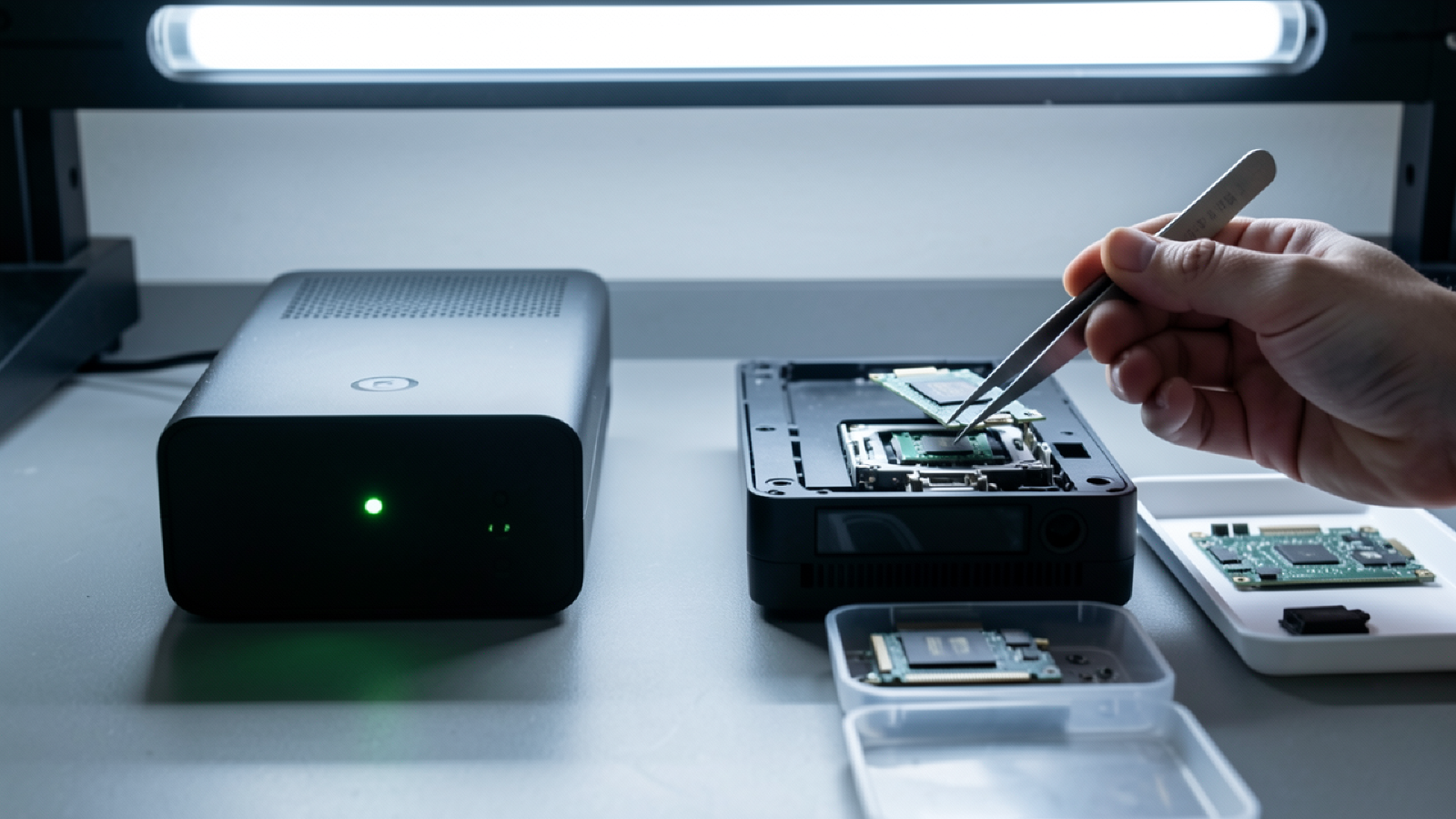
Models are not static. They degrade, drift, and become stale. The Medication Assistant that was accurate at deployment becomes less accurate as new medications enter the market and new interaction data becomes available. The Emotion Detector that was calibrated to voice patterns at launch drifts as it encounters vocal characteristics it was not trained on. The Nutrition Guide that reflected dietary research at training time falls behind as new studies are published. Every model in the portfolio is a living artifact that requires continuous monitoring, periodic validation, planned updates, and eventual replacement.
The lifecycle management architecture ensures that model quality does not decay silently. Every model is monitored in production, validated against benchmarks, updated through hot-swap deployment, and retired gracefully when its architecture is superseded. The person never sees this process. The build team always can.
A model that ships and is forgotten is a model that will fail. The question is when, not whether.
Monitoring#
Every model in the portfolio has three monitoring dimensions that run continuously in production.
Accuracy tracking compares model outputs against expected outcomes for a held-out validation set that runs on a scheduled cycle. The validation set is domain-specific: the Medication Assistant is tested against known drug interactions, the Intent Classifier is tested against labeled query examples, the Cognitive State Estimator is tested against clinical cognitive assessment benchmarks. When accuracy drops below the model’s threshold, an alert triggers. The threshold is model-specific: the Safety Monitor has a tighter accuracy threshold than the Activity Suggester because the consequences of a miss are different.
Latency tracking monitors inference time per model across device tiers. A model that met its latency target at deployment may exceed it as the device’s memory becomes more fragmented, as concurrent model load increases, or as the model’s input distributions shift toward longer sequences. Latency drift is often the first signal that something has changed in the deployment environment, even before accuracy drift appears.
Drift detection uses the FSSVA deviation signals (BMT-06.03) as the primary mechanism. When a model’s deviation score increases consistently across multiple validation cycles, the model is drifting. The drift may be benign: a shift in user interaction patterns that the model has not yet adapted to. Or it may indicate a problem: training data that no longer represents production conditions, a quantization artifact that accumulates over inference cycles, or a dependency on another model whose outputs have changed.
The three monitoring dimensions interact. A model may maintain accuracy on the validation set while drifting in production because the validation set no longer represents production conditions. Latency increases may mask accuracy problems by causing timeouts that trigger fallback responses. The monitoring system evaluates all three dimensions together, not independently, and flags models where any combination of metrics suggests degradation.
The practical consequence is visible in how a problem is detected. The Medication Assistant’s accuracy on the held-out test set remains stable at 97%. But the FSSVA deviation score for medication-related queries has increased 15% over six weeks. The monitoring system investigates: the deviation is concentrated in queries involving medications approved in the last three months, which are not in the training data and not in the held-out test set. The accuracy metric alone would have missed this entirely. The deviation signal caught it because it measures production performance, not test set performance. The lifecycle response: the Medication Assistant’s training data is updated with the new medications, the model is retrained, validated, and deployed through the hot-swap protocol.
Validation#
Monitoring detects potential problems. Validation confirms them and quantifies their severity.
Continuous validation runs the model against its held-out test set on a daily cycle. The test set is version-controlled and expanded as new edge cases are discovered in production. When a previously unseen medication interaction appears in production, the correct answer is added to the test set. The test set grows over time, and it grows in the direction of what the model encounters in the real world.
A/B testing validates updated models against the current production model before promotion. The updated model handles a fraction of production traffic, and its outputs are compared against the production model’s outputs on the same inputs. The comparison uses domain-specific quality metrics, not just generic accuracy scores. The Empathy Responder is evaluated on empathy calibration, not just intent accuracy. The Text Simplifier is evaluated on readability scores, not just semantic preservation. A/B testing runs for a minimum duration that provides statistical confidence that the updated model is at least as good as the production model on every quality dimension.
Clinical validation applies specifically to health-domain models. The Medication Assistant, Health Monitor, Cognitive State Estimator, and related models undergo periodic review by clinical advisors who evaluate output quality against clinical standards. Clinical validation catches errors that automated metrics miss: a medication recommendation that is technically accurate but clinically inappropriate given the patient’s age, a cognitive assessment that scores correctly on the clinical scale but misses a pattern that a neuropsychologist would recognize. Clinical validation is slower and more expensive than automated validation. It is also non-negotiable for models that influence health decisions.
Update and deployment#
When a model update passes validation, deployment uses a hot-swap protocol that eliminates downtime. Model updates distribute to two tiers. Zone 1 devices (Local Panes in subscriber homes) receive updates through over-the-air delivery, with staged rollout and automatic rollback if quality metrics decline (BMT-06.03). Zone 2 regional nodes (Community Panes) receive updates through a managed deployment pipeline with hot-swap capability: the new model version loads alongside the current version, traffic is gradually shifted, and the old version is retired only after the new version’s quality metrics are validated.
The hot-swap mechanism is the same at both tiers but the orchestration differs. At Zone 1, the device manages its own rollout because each Local Pane serves one subscriber and downtime affects one person at a time. At Zone 2, the regional node orchestrates rollout across the subscribers it serves, shifting traffic 5% to the new version initially, increasing to 25%, 50%, and finally 100% over a period that allows quality metrics to stabilize at each stage. If quality metrics decline at any stage, traffic reverts to the production version immediately. The rollback is automatic: no human decision required, no downtime incurred.
The hot-swap protocol means model updates are routine rather than risky. The team can update a model weekly if the validation pipeline produces a weekly improvement. The person experiences gradual quality improvements without service interruptions, without notification pop-ups, and without the anxiety that comes with “system update” screens on devices she depends on daily.
Over-the-air delivery pushes model updates to Zone 1 Local Pane devices when they are connected and idle. The update downloads in the background, validates its integrity through checksum verification, and stages for the next hot-swap cycle. If the download fails or the integrity check fails, the current production model continues operating. The person is never left without a working model because an update went wrong. The OTA system also respects bandwidth constraints: updates are compressed, prioritized by model criticality (safety models update first), and scheduled for times when the device is on Wi-Fi rather than cellular data. A typical Zone 1 model update is measured in megabytes, not gigabytes, because the models themselves are small.
Zone 2 model updates do not use OTA delivery. They are pushed through a managed deployment pipeline from the BlueMirror build infrastructure to each Community Pane node. The pipeline coordinates the hot-swap rollout across the regional node’s subscriber population and reports back validation metrics during each stage. Updates can be paused or rolled back centrally if a problem surfaces across multiple nodes, which is the kind of failure that OTA distribution to independent Zone 1 devices cannot easily address.
Retirement#
When a model’s architecture is superseded, the old model does not disappear immediately. The earlier version of any model that is being replaced by an architecturally newer version continues running as a fallback for 90 days after the new version is promoted to production. During the fallback window, any quality regression in the new version can trigger an automatic revert to the prior version. After 90 days with no revert, the earlier version is archived: removed from active deployment but preserved in the model repository for forensic analysis or emergency recovery.
The retirement protocol ensures that architectural transitions, the most risky moment in a model’s lifecycle, have a safety net. The system does not bet on the new architecture without maintaining access to the old one. The SSM must prove itself in production before the Transformer it replaced is removed. This principle applies to every model transition, not just architecture changes: when a model is retrained on updated data, the previous version remains available for rollback during the evaluation window. The lifecycle system treats every model version as potentially needed until it has been conclusively superseded.
Versioning#
Every model in the portfolio carries a version identifier, a training date, a training data snapshot identifier, a validation score across all quality dimensions, and a deployment history. The version record answers questions the build team needs during debugging: which version of the Medication Assistant was running when this interaction happened? What training data was it trained on? What was its accuracy score at deployment? When was it last updated?
The person never sees version numbers. She sees the response she gets. The version system exists to ensure that the response she gets is traceable to the specific model, specific training data, and specific deployment configuration that produced it. Traceability matters when something goes wrong, and it matters for regulatory compliance in health-domain models where the FDA or other bodies may require documentation of which model version produced which clinical recommendation.
Cross-References#
BMT-06.03 Edge Intelligence. FSSVA as the monitoring backbone that generates the deviation signals the lifecycle system acts on.
BMT-09.04 When Things Break. Failure recovery protocols that depend on the hot-swap and rollback capabilities the lifecycle system provides.
BMT-02.SYN The Invisible Orchestra. The orchestration-level view that depends on every model in the portfolio maintaining production quality through lifecycle management.
Technical Appendix BMT-06.05-A is available to partners and investors at partners.bluemirror.tech.