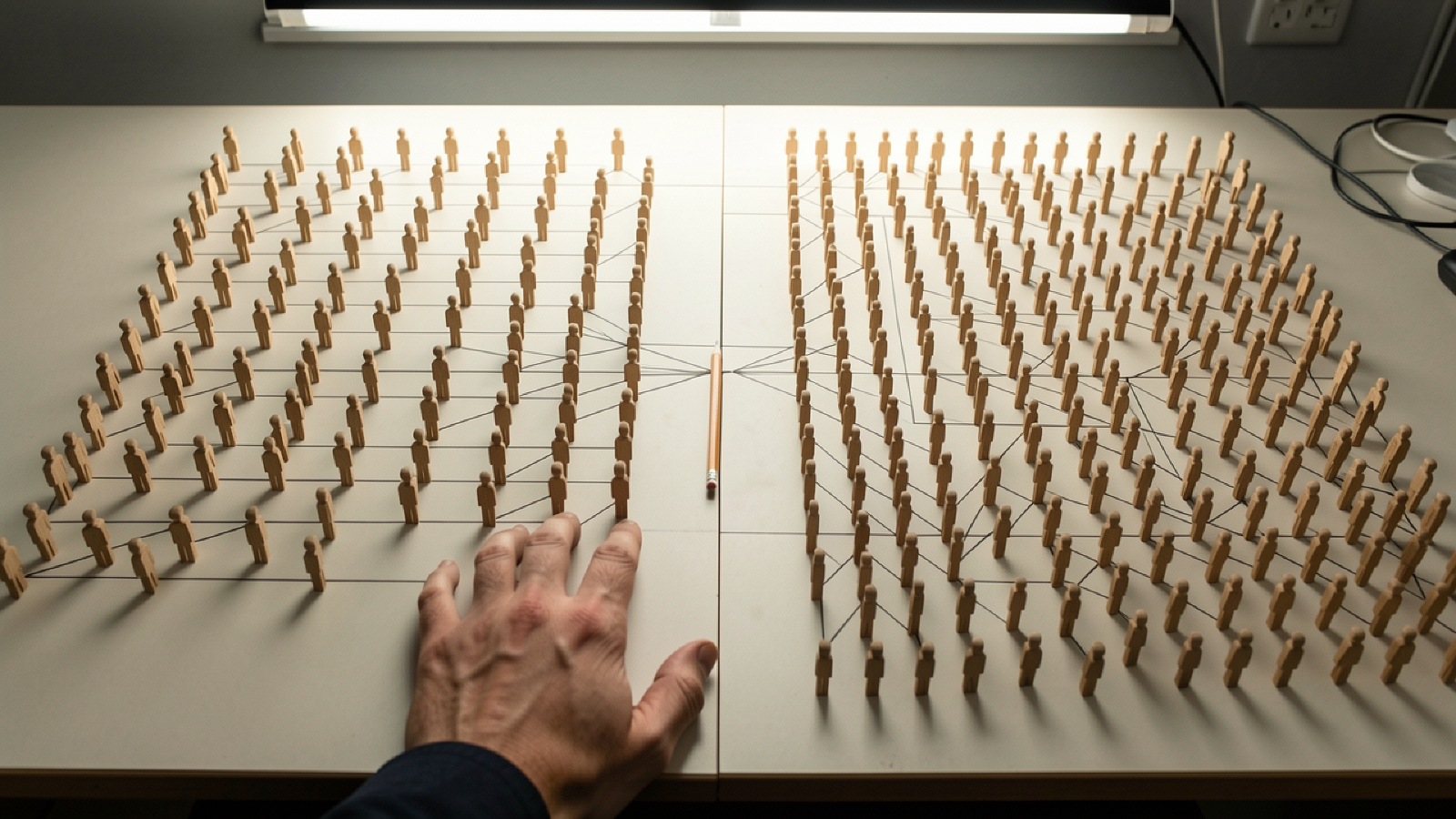
Denise Kamara runs a home care agency in southeast Michigan with 200 active clients and 28 aides. She knows her economics to the dollar. One aide serves eight to twelve clients depending on geography and acuity. When she adds clients, she hires aides. When she loses an aide, she loses capacity. Her revenue scales linearly with her headcount, and her headcount scales linearly with her client base. She has been running this business for fourteen years and the math has never changed.
The pitch she keeps hearing from technology vendors is that their platform will “replace” some of her aides. She stops listening at that point. Nobody replaces the aide who helps Mr. Washington get dressed in the morning. What she wants to know is whether a technology platform can let her existing staff serve more people without burning out, whether it can reduce the documentation burden that costs her aides 12–15 minutes per visit in paperwork, and whether it changes the math that has governed her business since she founded it.
The human care economics ceiling#
Denise’s math is the industry’s math. One aide serves eight to twelve clients. One care coordinator manages forty clients. One nurse supervisor oversees six to eight aides. The staffing ratios are fixed by the physical requirements of care: you cannot bathe two people at once, you cannot be in two homes at the same time, and you cannot document a visit while providing care during that visit.
When the agency grows from 200 to 300 clients, it needs approximately ten more aides, two more coordinators, and one more nurse supervisor. The cost grows proportionally. Revenue per client is approximately $2,500–4,000/month depending on acuity and payer mix. Cost per client is approximately $2,000–3,200/month, most of it labor. Margin is thin and constant. Scale does not create efficiency because the ratio of staff to clients does not change. An agency with 50 clients and an agency with 500 clients operate at roughly the same margin percentage. The larger agency has more revenue, but its cost structure is proportionally identical.
This is the ceiling that every home care operator, and every PE firm evaluating home care rollups (BMT-10.04), runs into. You can consolidate agencies to reduce back-office overhead. You can improve scheduling to reduce drive time. You can standardize training to reduce turnover costs. But you cannot change the fundamental ratio of caregivers to clients without changing what the caregiver does during each visit.
Platform economics across paths#
BlueMirror’s scaling profile is different because the platform layer is infrastructure, not labor.
Zone 2 regional nodes serve 150–500 concurrent subscribers on the same hardware, depending on query load and concurrent session patterns. The GB10 pair at a regional facility performs inference for every subscriber connected to that node. Adding the 151st subscriber to a node that serves 150 does not require hiring anyone. It requires a fraction more compute from hardware that is already running. The cost increase is the electricity for the additional inference cycles.
Zone 3 cloud inference scales elastically. Adding subscribers to the cloud tier is a capacity allocation decision, not a staffing decision. Ten thousand subscribers or one hundred thousand subscribers on Zone 3 changes the cloud compute bill, not the headcount.
The difference from human care scaling is worth stating precisely. When Denise adds her 201st client, she needs to hire a new aide if her existing aides are at capacity. The cost is $3,500–4,500/month in wages, benefits, and overhead. The aide serves eight to twelve clients. The marginal cost per new client is $300–550/month in labor alone. When BlueMirror adds its 201st subscriber to a Zone 2 node that is running at 150 concurrent sessions, the marginal cost is the additional inference compute: approximately $0.15–0.40/month in electricity and GPU wear. The difference is three orders of magnitude. This is what platform economics means in concrete terms for care delivery.
Step-function scaling occurs at Zone 2. When subscriber density in a region reaches the capacity of the existing node (approximately 500 concurrent subscribers), BlueMirror adds another node: another GB10 pair, another hosting arrangement, another $10,000 in hardware amortized over three years. This is a capital expenditure that serves the next 500 subscribers. It is not a recurring labor cost that grows with every individual. The effective cost of the step is $0.56/subscriber/month amortized. Even the step function costs less per subscriber than one hour of aide labor per year.
Path mix affects the scaling profile. A region with high Path A penetration (subscribers who have dedicated Local Pane devices and access a Zone 2 node) scales through Zone 2 node additions. A region with high Path F penetration (subscribers without devices who rely on Zone 3) scales primarily through cloud capacity. Both work. Both avoid the linear-with-headcount scaling that governs human care.
Where human care remains essential#
The platform does not replace Denise’s aides. It cannot.
Hands-on personal care requires physical presence. Bathing, dressing, toileting, mobility assistance, wound care: these are tasks that no amount of AI can perform because they require a human body in the room. Complex medical procedures require trained clinical hands. Emotional presence during a crisis, the daughter who just received a diagnosis and needs someone sitting next to her, requires a human being who is present, not a voice from a speaker.
Physical home safety assessment requires eyes and judgment in the space. The home environment concierge can monitor sensor data and flag anomalies (BMT-01.12), but the initial assessment of whether the bathroom grab bar is properly anchored requires a person who can pull on it. The fall risk assessment that determines whether the living room rug needs to be removed requires a person who can see the rug, feel the floor underneath, and assess the client’s gait pattern in that specific space.
These functions remain human regardless of which deployment path the subscriber is on. Technology vendors who promise to “replace” human care are selling something that does not work. The platform’s value is not in replacing these functions. It is in extending the capacity of the people who perform them, so that the time they spend in the home is spent on care rather than on documentation, coordination, and administrative tasks that a platform can handle.
Where the platform extends human capacity#
Documentation is the clearest win. Denise’s aides spend 12–15 minutes per encounter on documentation: visit notes, medication administration records, condition changes, care plan updates. The care coordination agent generates visit documentation from the interaction data it already collects. The aide reviews and approves in 3–5 minutes rather than writing from scratch. At eight visits per day, this saves 56–80 minutes per aide per day. That is one additional visit per day, or more time per existing visit, without adding hours.
Care coordinator caseload increases because the platform handles routine coordination. Appointment reminders, medication adherence checks, benefits enrollment follow-ups, family communication summaries: these consume the coordinator’s day. With the platform managing routine coordination, the coordinator’s effective caseload increases from forty clients to sixty or more, not because she works harder, but because the platform handles the tasks that were consuming her time on coordination that does not require human judgment.
The family member who calls every night to check on her mother gets a daily summary generated by the system. The coordinator who spent fifteen minutes on that call now has those fifteen minutes for the client whose situation actually requires human assessment. The daughter who used to call Denise’s office four times a week to ask about medication changes now checks the family dashboard. Multiply by forty clients. The time recovery is substantial.
These benefits apply across deployment paths. A Path F subscriber’s care coordination produces the same documentation summaries as a Path A subscriber’s. The agent layer that generates the documentation runs in whichever zone serves the subscriber. The output quality is the same because the agent logic is the same. The documentation for the aide who visits a Path F subscriber is generated by the same care coordination agent that serves Path A subscribers. The zone where inference runs is invisible to the aide and the coordinator.
The density math#
Model a 200-client agency, Denise’s agency, with and without BlueMirror.
Without the platform: 28 aides, 5 coordinators, 3 nurse supervisors. Monthly labor cost: approximately $480,000. Revenue: approximately $600,000. Margin: approximately $120,000 (20%).
With the platform: documentation time reduction allows each aide to serve 10–14 clients instead of 8–12. Coordinator caseload increases from 40 to 60+. The agency now serves 200 clients with 23 aides instead of 28, 4 coordinators instead of 5, same number of nurse supervisors. Monthly labor savings: approximately $55,000. Platform cost: 200 subscribers × $40/month institutional rate = $8,000. Net monthly savings: approximately $47,000.
The agency does not fire five aides. It grows to 250–280 clients with the same 28 aides and absorbs the growth with existing staff. Revenue increases by 25–40%. Margin increases both in absolute terms and as a percentage. The density gain is real: same staff, more clients, better documentation, less burnout.
Hospitalization reduction adds a second benefit layer. The platform’s medication adherence monitoring and early condition-change detection reduce avoidable hospitalizations. Each avoided hospitalization saves $15,000–47,000 depending on the cause. For a 200-client agency, even a modest reduction of two fewer hospitalizations per month represents $30,000–94,000 in system savings that strengthen the agency’s value-based contract performance. The agency captures a portion of this through shared savings arrangements with its payer partners.
Staff retention improves because documentation burden is the number-one complaint among home care aides. Reducing it by 60–70% makes the job less exhausting and more focused on care. Turnover in home care exceeds 60% annually in many markets. Even a ten-percentage-point reduction in turnover saves Denise $3,000–5,000 per aide in recruitment and training costs.
Density gains are realized whether the agency’s clients are on Path A, Path C, or Path F. The documentation reduction works on every path. The coordinator caseload improvement works on every path. The hospitalization reduction works on every path. The density argument does not depend on subscriber hardware. It depends on the platform handling work that currently consumes human time, regardless of which zone performs the computation.
Denise’s question was whether the technology changes the math. The math changes: same infrastructure of aides, coordinators, and supervisors serves more people, with less documentation burden, better outcomes, and higher retention. The platform does not make the aide obsolete. It makes the aide’s time count for more.
Cross-References#
The Institutional Channels (BMT-09.03). The care agency deployment model that determines how agencies integrate with BlueMirror’s infrastructure.
The Unit Economics (BMT-10.01). The per-subscriber cost profiles that determine the institutional rate agencies pay.
What This Does to Cost Structure (BMT-10.06). The specific savings categories that produce the density economics described here.