BMT-02.01 Executive Summary#
BlueMirror.tech | May 2026#
Priya Raman is a lead orchestration engineer who notices something in her latency dashboard. Three different query paths through the BlueMirror system take 180, 470, and 720 milliseconds respectively. None are out of budget. All are different. The variation is not a bug. It is the shape of the architecture: simple requests touch fewer components, complex ones touch more, and the reasoning layer that coordinates them all takes time proportional to how much it has to hold.
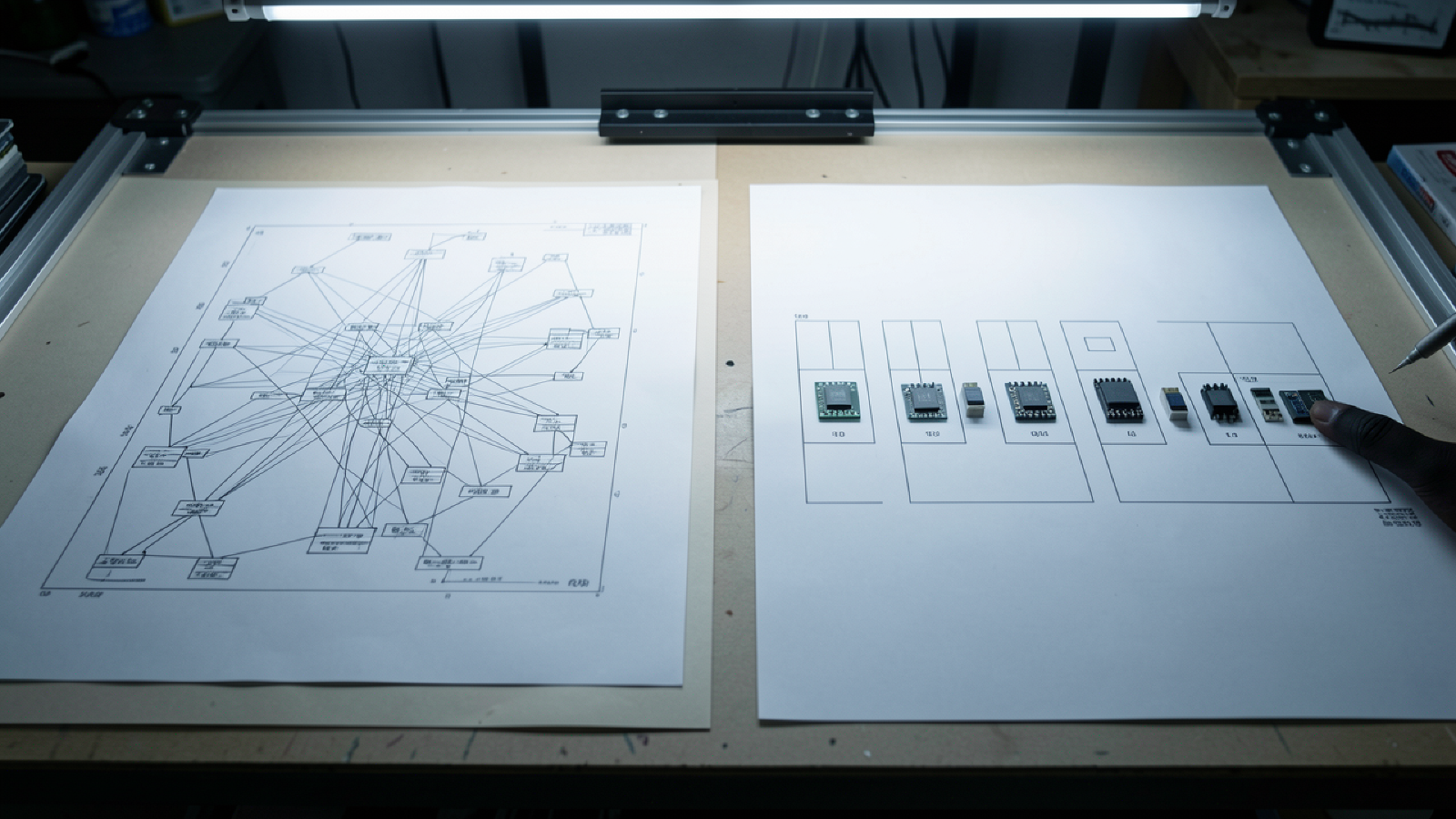
That reasoning layer is the H-layer — the brain. It runs one instance per user, holds the full Mixture of Context for that person, applies her Personalized Reinforcement Learning from Human Feedback preferences, and directs a set of fast, specialized execution components called L-layer skills. The architectural commitment is explicit: one slow, deliberate brain directs many fast, specialized hands.
The alternative architectures are both obvious and both inadequate. A single general model could hold the full picture of the person and reason coherently across health, finance, family, and home. The cost is speed: a model large enough to do this well cannot run on edge hardware, cannot meet sub-200-millisecond safety requirements, and cannot be updated incrementally when one domain’s logic needs to change. On the other side, many independent models could each be small, fast, and focused. The cost is coherence: a health model and a financial model with no shared awareness produce recommendations that do not contradict each other in any logical sense but simply do not know about each other. The person experiences a committee of specialists who are not speaking.
The hybrid model holds the middle. The H-layer does five things: cross-domain reasoning, delegation decisions, multi-step workflow planning, P-RLHF preference application, and Human Agency Scale evaluation before any action proceeds. It does not run inference on user-facing language. It does not check medication databases. It does not assess vital signs. Each of those belongs to a skill that does it faster. The H-layer is slow because it thinks. The thinking has to be coherent, and coherence requires holding the full picture.
The L-layer skills are stateless, distributed, and shared across users. They receive a context package from the Mixture of Context router, execute one domain-specific task, and return a structured result. The granularity principle governs their design: “Refill prescription” is the right level of abstraction. “Make HTTP POST to pharmacy API” is too narrow. “Handle health” is too broad. The middle level is where the architecture earns its keep, because skills at that level are independently updatable, independently testable, and reusable across multiple concierge agents without modification.
The Mixture of Context router sits between the layers, building context packages in roughly 25 milliseconds. It selects minimum necessary layers, applies token budget constraints per skill, and delivers roughly 800 tokens where a naive approach would load 5,000. The 85% token reduction is a target average across query types, not a guarantee on any individual query. Cross-domain queries that touch four or five context layers run higher. Highly specialized queries that need only the core identity and one domain layer run lower. The reduction is what allows the latency budget to close at scale.
The hardest engineering problem in the orchestration layer is not speed. It is consistency. When Margaret tells the health concierge to stop monitoring her blood pressure, the financial concierge must not mention blood pressure medication costs five minutes later. The architectural answer is a split: strong consistency for preference changes (the change is visible to every component before any component proceeds), eventual consistency for context updates that do not affect user-facing behavior. The split is a genuine tradeoff: strong consistency costs latency; eventual consistency risks staleness. The boundary between the two is what makes the system feel responsive without producing contradictions that expose the multi-agent structure to the person using it.
The Phase 1 deployment runs the entire orchestration logic through Zone 3, the cloud reasoning layer, for every subscriber. The H-layer and L-layer decomposition is identical in every phase. The substrate changes as Zone 1 and Zone 2 come online for subscribers who acquire the relevant hardware or live in served regions. The code paths the H-layer executes are the same in every phase. The routing table is what changes.
For partners and investors, the H-layer and L-layer separation produces three properties worth naming. Modularity: new capabilities add as new L-layer skills without touching the H-layer. Testability: each skill tests against a synthetic context package without standing up the full system. Scalability: the L-layer is shared across users, so adding a user does not require fifteen times the model capacity. The partner integration point is the L-layer. A partner builds a skill, declares its context requirements, registers it with the router, and receives invocations when the H-layer determines it is the right hand for the job.
The full article, including the LangGraph state machine specification and the strong-consistency synchronization protocol, is at BlueMirror.tech.