Wei-Lin Park is a robotics integration engineer at a home robotics company in the Bay Area. The company builds a multi-task home robot in the segment between vacuum robots and humanoid platforms: a mobile base with arms, capable of fetching objects, opening doors, helping with light kitchen tasks, and providing physical support during transfers from chair to chair. The hardware is mature enough for limited consumer deployment. The software is the bottleneck. Specifically, the software does not know enough about the person in the home to act in the person’s interest without explicit instruction for each task.
She has spent eighteen months working on the contextual model: what does the robot need to know about a 76-year-old woman with arthritis and early Parkinson’s to fold her laundry the way she wants it folded, or to bring her a glass of water without waking her from her midmorning nap, or to know that her daughter is visiting today and will want to be the one helping with the bath? The model the robotics company has built captures some of this. It does not capture enough. And every household the robot enters starts the contextual model from zero, because the robot’s local learning is bounded by what it can observe directly.
The architectural question Wei-Lin’s team has put on the table is whether to keep building the contextual model in-house, or to integrate with a context provider whose architecture is purpose-built for the persistent, privacy-respecting, multi-domain context model the robot needs. BlueMirror is one of the candidates her team is evaluating. The integration question is not “can the robot get context from BlueMirror?” The answer to that is yes. The question is “what does that integration look like across different deployments, and what privacy posture does it inherit?”
The Robot Problem#
Home robots fail in subtle ways that compound. A vacuum robot cleans the bedroom while the subscriber is napping, because it does not know she is napping or that this room is currently a do-not-disturb zone. A medication reminder robot prompts her to take her midday pill, again, because she already took it twenty minutes ago and the robot does not know. A mobility assistance robot offers help with a transfer when her daughter is the one who should be helping with the transfer today, because the robot does not know the daughter is visiting.
The failures are not failures of the robot’s physical capability. The robot’s actuators work. Its sensors work. Its task-execution code works. The failures are failures of context. The robot does not know what the person actually wants, in this moment, given what she did this morning, what her body and mind are doing now, who is in the house, and what is on her calendar.
The robotics industry has approached this problem by building in-house context models. Each manufacturer’s model starts from zero in each home. Each model learns a subset of the person from what its sensors can observe. No manufacturer’s model has the clinical context the health concierge holds, the financial context the financial concierge holds, the social context the family coordination concierge holds, the daily-pattern context the home environment concierge holds. The robot operates on a thin slice of the person’s situation, and the gap between the slice and the situation is where the failures live.
The architectural alternative is to separate the robot from the context provider. The robot is responsible for physical capability. The context provider is responsible for knowing the person. The robot calls the context provider for the contextual information it needs to act well.
BlueMirror as Context Provider#
The architecture exposes context to authorized external systems through the membrane (described in BMT-03.01). A robot integrates as an external agent. It establishes its trust posture through the partner integration framework (BMT-03.05). It receives, for each task or interaction, the minimum necessary context to perform the task well: the subscriber’s current location and activity state, the cognitive and physical state relevant to the task, the communication preferences for any spoken interaction, the safety constraints the home environment concierge has established for the current state.
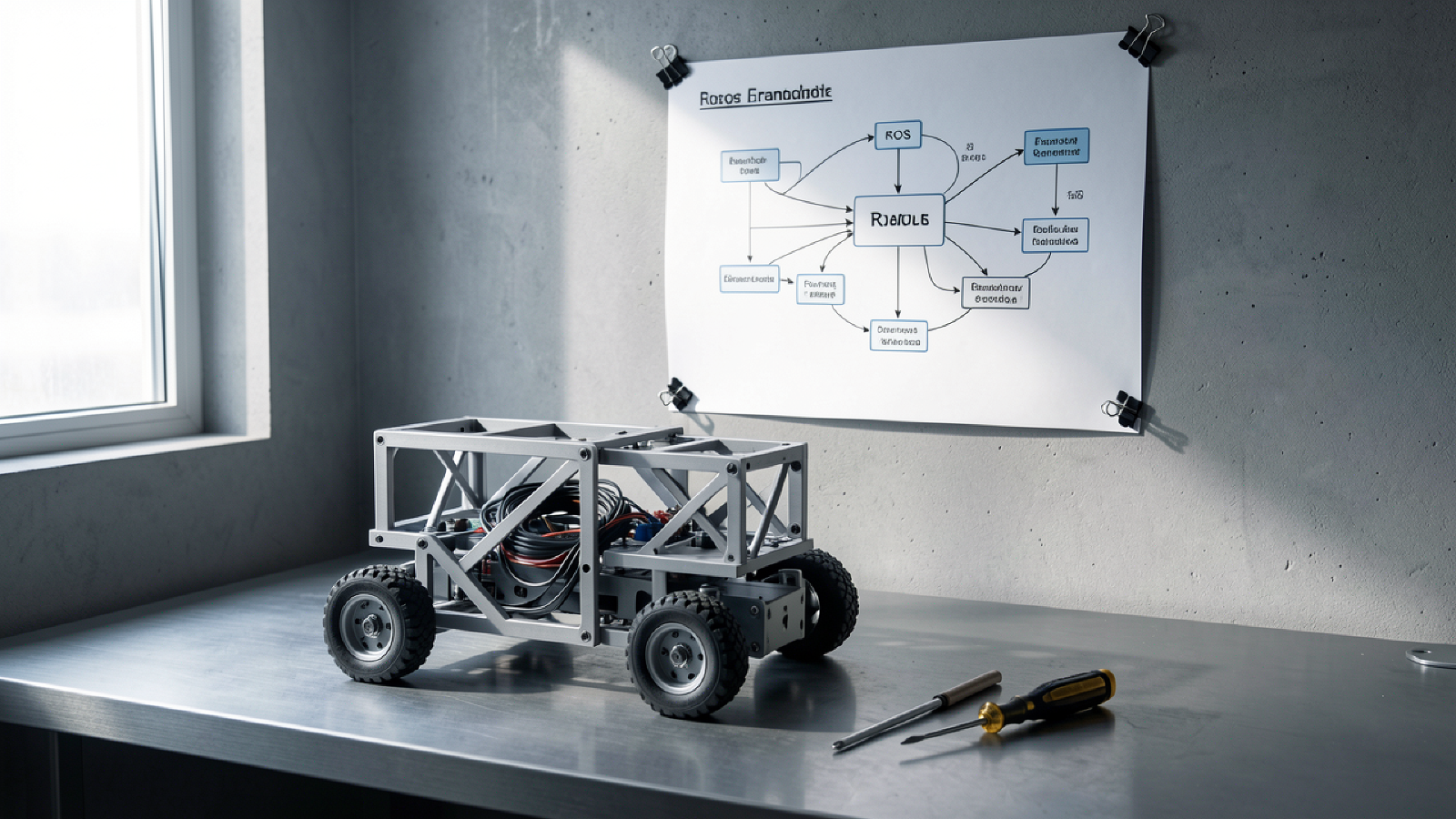
The context flows through a ROS-compatible API. ROS, the Robot Operating System, is the open-source middleware most modern robotics platforms use. A BlueMirror-aware robot publishes context-request messages to the ROS bus. The BlueMirror integration layer subscribes to those requests, queries the membrane for the appropriate context release, and publishes the context back to the ROS bus as a structured message. The robot’s planning and execution code consumes the context. The action runs with awareness.
The home environment concierge (BMT-01.12) is the integration seat for robotics. The reason is structural. The home environment concierge already holds the spatial model of the home, the activity state of the occupants, the safety zones, the lighting and temperature context, and the relationships among devices in the home. The robot adds one more device class to a context model that already exists. The concierge’s existing context-gate architecture handles the robot’s permissions and context releases through the same mechanism it uses for thermostats, lights, and ambient sensors. The robot is not a special case. It is a more capable device in a context model that was designed for varied devices.
The same architecture handles the cross-occupant case. Margaret asks the robot for help with her Japanese recipe; the robot receives Margaret’s nutrition context, her ingredient substitutions, her cognitive state, the appropriate pacing for instructions. Her grandson asks the robot for help with a science homework problem; the robot receives the grandson’s age-appropriate context, his learning style, his current attention state, the parental permissions in effect. Same hardware, same kitchen, different personalization. The personalization comes from BlueMirror. The robot does not learn about Margaret and the grandson independently. It queries the context provider for each interaction.
Integration Path A: Local Pane Bridge#
For subscribers with a Local Pane device (a residential compute appliance in the GB10-class hardware envelope), the integration runs locally. The Local Pane hosts a ROS bridge that communicates directly with the home robot over the local network. Privacy-critical context (cognitive state, emotional state, current location, recent medication events) is released from Zone 1 without ever leaving the home. The robot’s contextual queries are answered within the home’s network boundary. The robot operates with the privacy posture of Zone 1: the data substrate that drives its behavior is local, the audit trail is local, the inference is local.
This is the lowest-friction integration path for both the subscriber and the robotics partner. The latency is sub-50-millisecond for most context queries because the inference is co-located with the robot. The privacy disclosure to the subscriber is the simplest: the data that drives the robot’s behavior does not leave her home. The robotics partner’s compliance posture is the lightest because the partner is not handling protected data; the partner is consuming context output that the Local Pane has packaged and approved.
The Local Pane device, in this integration, functions as the sensor hub and context coordinator the home robotics ecosystem has been missing. It is the architectural seat that the home environment concierge runs on, and it is the integration point for any robot that joins the home.
Integration Path B: Cloud Bridge#
For subscribers without a Local Pane, the integration runs through a cloud bridge. The robot’s context queries go to Zone 2 (the regional Community Pane, where deployed) or Zone 3 (the cloud reasoning tier). The Community Pane covers context queries that need regional context coordination but do not require the data residency posture of Zone 1. Zone 3 covers context queries that benefit from the deepest reasoning the system offers and do not have a hard residency requirement.
The privacy posture follows the residency model for the deployment path. Zone 2 inherits the architectural privacy posture of the regional node (privacy-by-construction within the regional infrastructure, with the same audit and consent architecture as Zone 1 but with regional rather than local data residency). Zone 3 inherits the contractual privacy posture (privacy-by-contract through the data processing agreement, with cryptographic audit and the same consent architecture as Zones 1 and 2).
The integration is functionally equivalent for the robot. The robot publishes the same context-request messages over the same ROS-compatible API. The integration layer routes the queries to the appropriate zone based on the subscriber’s path and the query’s residency requirement. The robot does not know whether it is talking to a Local Pane or a cloud bridge. The robot’s code is identical across paths.
What differs is the subscriber’s privacy posture. A subscriber on Path A (Zone 1-Dedicated) has the strictest residency guarantee for the data driving her robot. A subscriber on Path F (Zone 3-only) has the contractual residency posture that applies to all her interactions. The robot serves both subscribers with the same product quality. The architecture’s contribution to the privacy posture differs by path.
The Robotics Subscriber Population#
The early adopters of home robotics that integrate with BlueMirror are subscribers who already own home robotics and who are on Path A or Path B (subscribers with a Local Pane device). The integration is most natural on these paths because the Local Pane is the sensor and coordination hub. The robotics partner integrates with the Local Pane through the local ROS bridge. The deployment is bounded by the subscriber population that has both a robotics device and a Local Pane.
As home robotics becomes more common across the subscriber population, the cloud-bridge integration extends the deployment to subscribers on other paths. The cloud-bridge integration is more involved on the privacy disclosure side (subscribers need to understand that the data driving their robot is processed regionally or in the cloud, depending on their path) but is functionally equivalent on the robot side. The robotics partner’s product team does not maintain two integration codepaths; the routing is handled by BlueMirror’s integration layer.
What the architecture does not assume is that every subscriber will have a robot. Home robotics is an option, not a default. Subscribers without robots still receive the full product. Subscribers with robots receive a more capable home environment because the robot is one more device that the home environment concierge coordinates. The robotics integration is an extension, not a requirement.
Timeline#
The ROS-compatible context API is in design now (2026). Prototype integrations with two robotics partners are under construction; the first integrations are scheduled to ship in 2027 as proofs of concept on the Path A subscriber base. Broader commercial deployment, including the cloud-bridge integration for non-Path-A subscribers, is a 2028-to-2029 timeframe. The pace depends as much on the home robotics market’s maturation as on BlueMirror’s build velocity. The integration is ready before the robots are widely deployed in the homes of the subscriber population. The architecture is built today against a future the robotics industry is approaching.
Wei-Lin’s evaluation, when she finished it, recommended that her company commit to the BlueMirror integration as the primary context source for home deployments and continue to maintain a minimal in-house contextual model only for environments where BlueMirror is not present. The recommendation was based on the architectural separation: her company is good at robots. BlueMirror is good at context. The combination is better than either company building both. Her company has shipped robots since 2022. They have spent four years building contextual models that work in approximately 30% of deployments. The integration path takes that variable out of the product equation.
Cross-References#
The Home Environment Concierge (BMT-01.12). The agent that holds the home’s context and serves as the integration seat for home robotics.
The Five Layers (BMT-05.01). The Memory of Context hierarchy that the robot queries for personalization.
The Three-Zone Architecture (BMT-09.01). The compute deployment that determines whether the robot integrates through a Local Pane bridge, a Community Pane bridge, or a cloud bridge.
The Partner Integration Guide (BMT-03.05). The framework that the robotics partner uses to establish trust, integrate with the membrane, and operate within the context-release model.
Technical Appendix BMT-12.02-A is available to partners and investors at partners.bluemirror.tech.